High-Precision Nanoscale 3D Microstructure Fabrication Technology
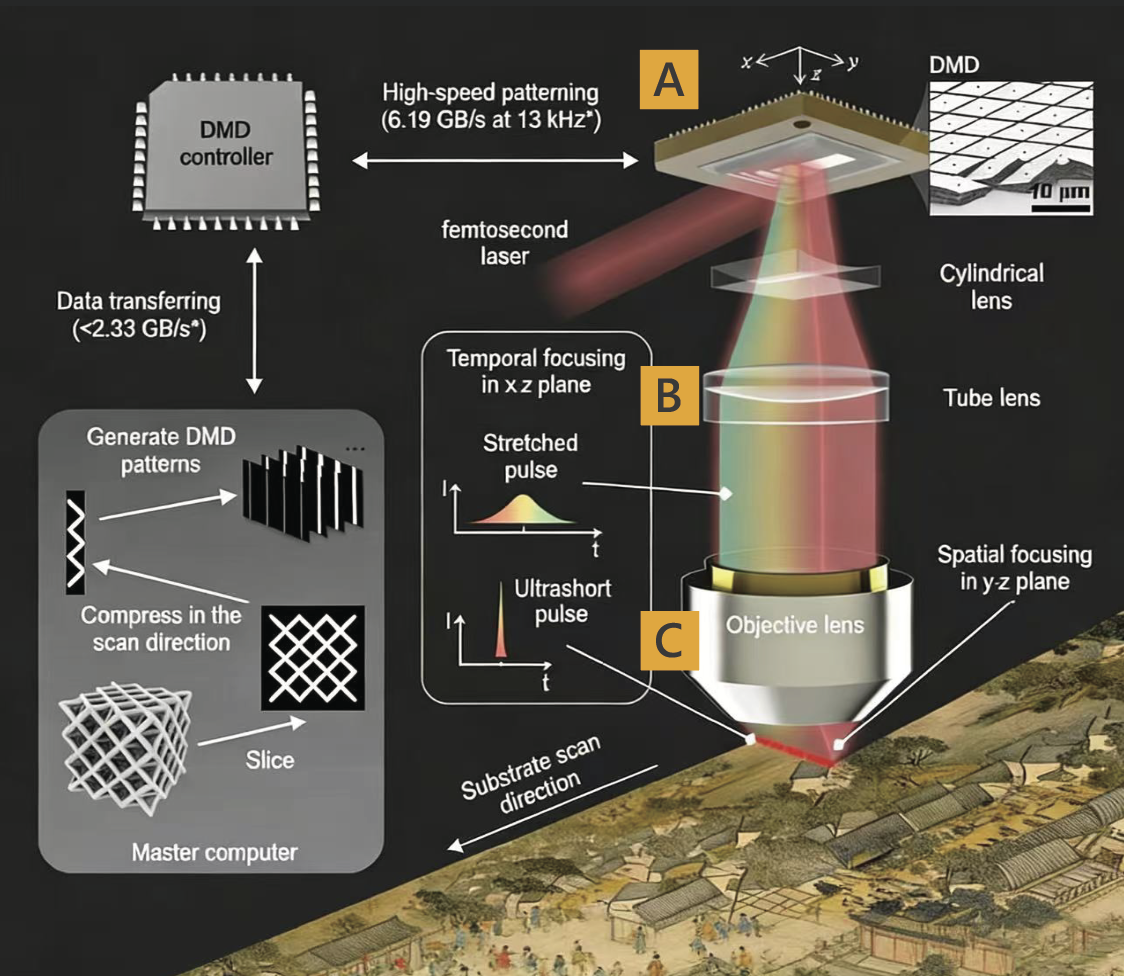
A:Creating Line Patterns
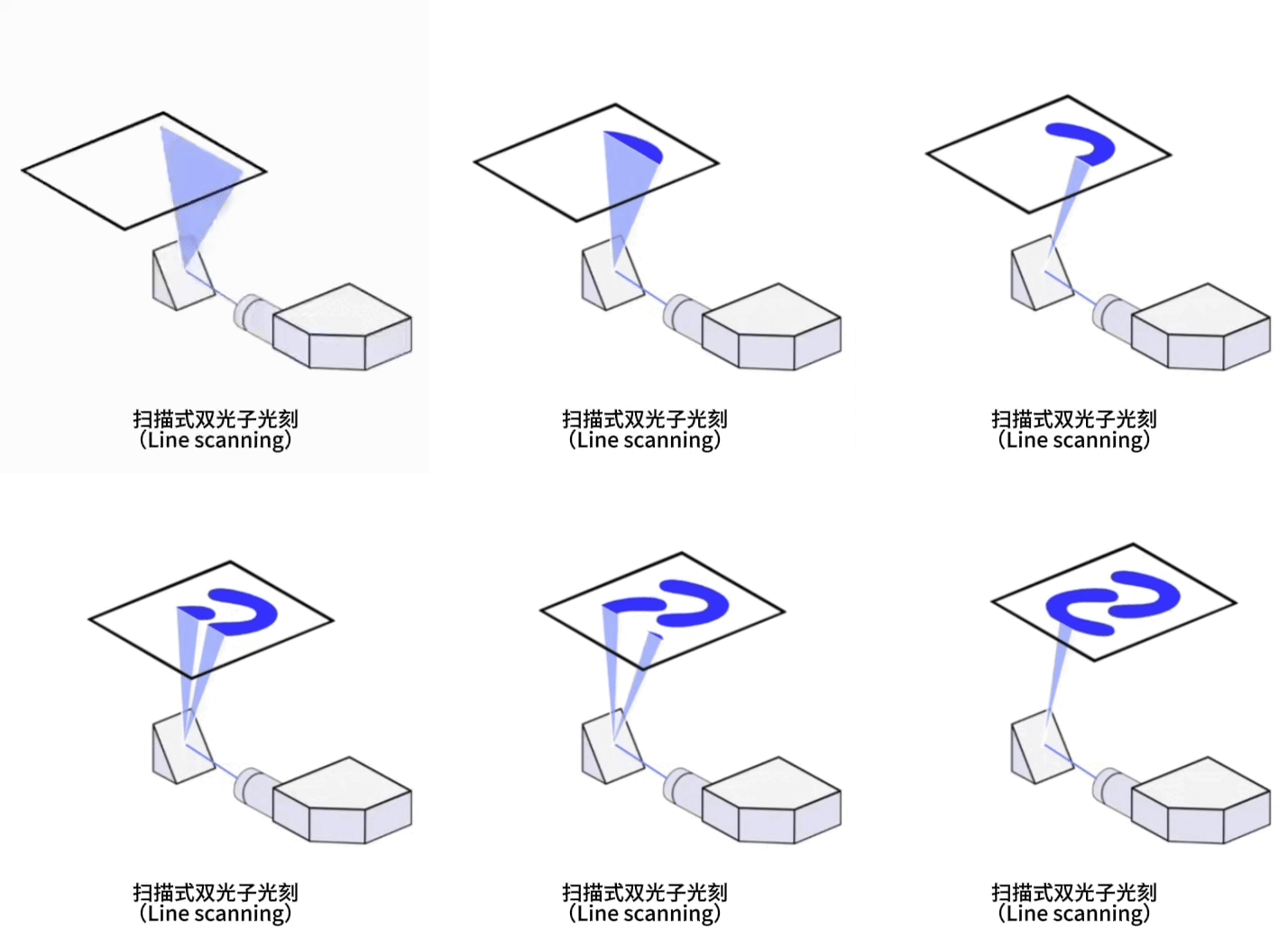
The femtosecond laser beam is directed onto a digital micromirror device (DMD), which acts as a precision mask, shaping the laser into programmable line patterns. Each mirror can be switched on/off independently, and the grayscale intensity can be controlled.
B:Spatiotemporal Focusing
The DMD disperses the different wavelengths of the femtosecond laser pulses in the time domain (femtosecond pulse stretching), while a cylindrical lens compresses the beam in the vertical direction (y-direction). When these femtosecond pulses recombine at the focal plane of the objective lens, they converge into a line.
C:Continuous Printing
The substrate moves smoothly beneath the focused line in a scanning motion, like a conveyor belt, while the DMD patterns change at a frequency of up to 13,000 times per second, precisely synchronized with the stage motion.
This technology achieves 1,600 levels of continuous grayscale adjustment from 10% to 100% intensity by precisely controlling the number of “on” pixels along the Y-axis via a DMD (digital micromirror device), and supports real-time dynamic updates at 13 kHz. Compared to other binary or computationally intensive holographic techniques, Line-TF TPL not only enables simultaneous fabrication of 75 nm nanowires and macroscopic structures within the same task, but also possesses near-isotropic axial resolution, extremely low computational overhead, and highly repeatable, stable printing performance.
A partial view of Along the River During the Qingming Festival printed by Astra Optics Limited’s LINESCAN 100i
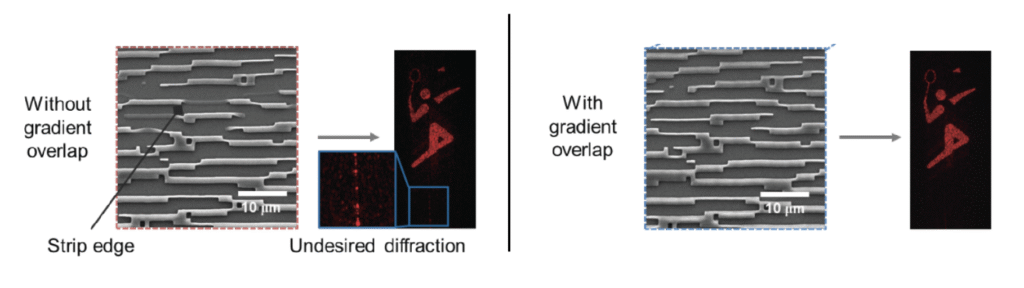
Breakthrough Grayscale Lithography Technology
Traditional binary lithography
Only two states: on/off
Unable to achieve continuous intensity variation
Stepped surface with visible boundaries
LINE-TF Grayscale Lithography
1,600 grayscale levels
Pixel-level precise control
Smooth continuous transition
Key Features
Sub-micron Fabrication Resolution
Arbitrary 3D Structure Control
Compatible with Various Photosensitive Materials
Enables 3D Structure Fabrication Without Multi-step Exposure
Application Scenarios
Biomedical Scaffolds
Optical Functional Structures
MEMS Devices (Micro-Electro-Mechanical Systems)
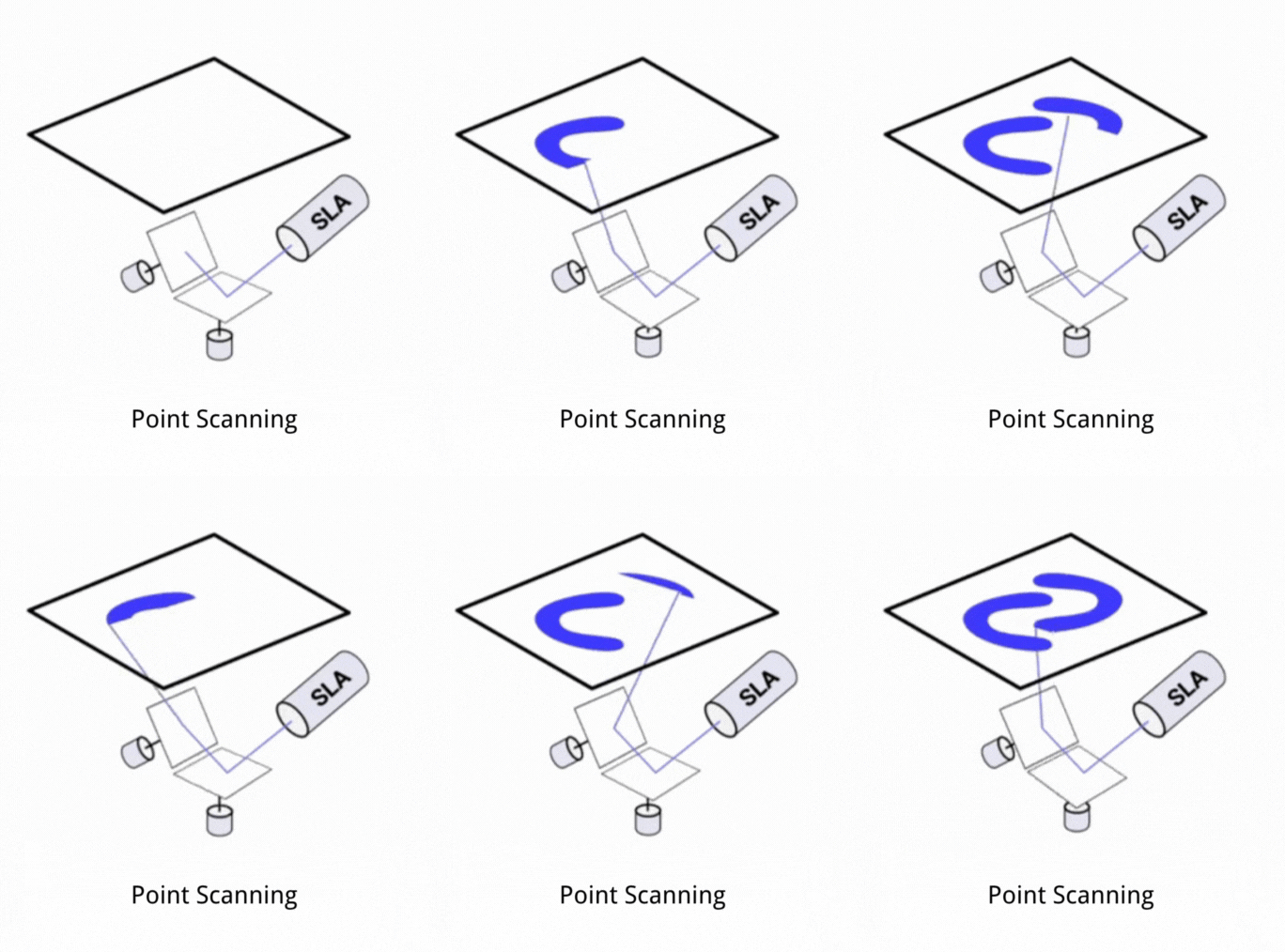
Line Scanning
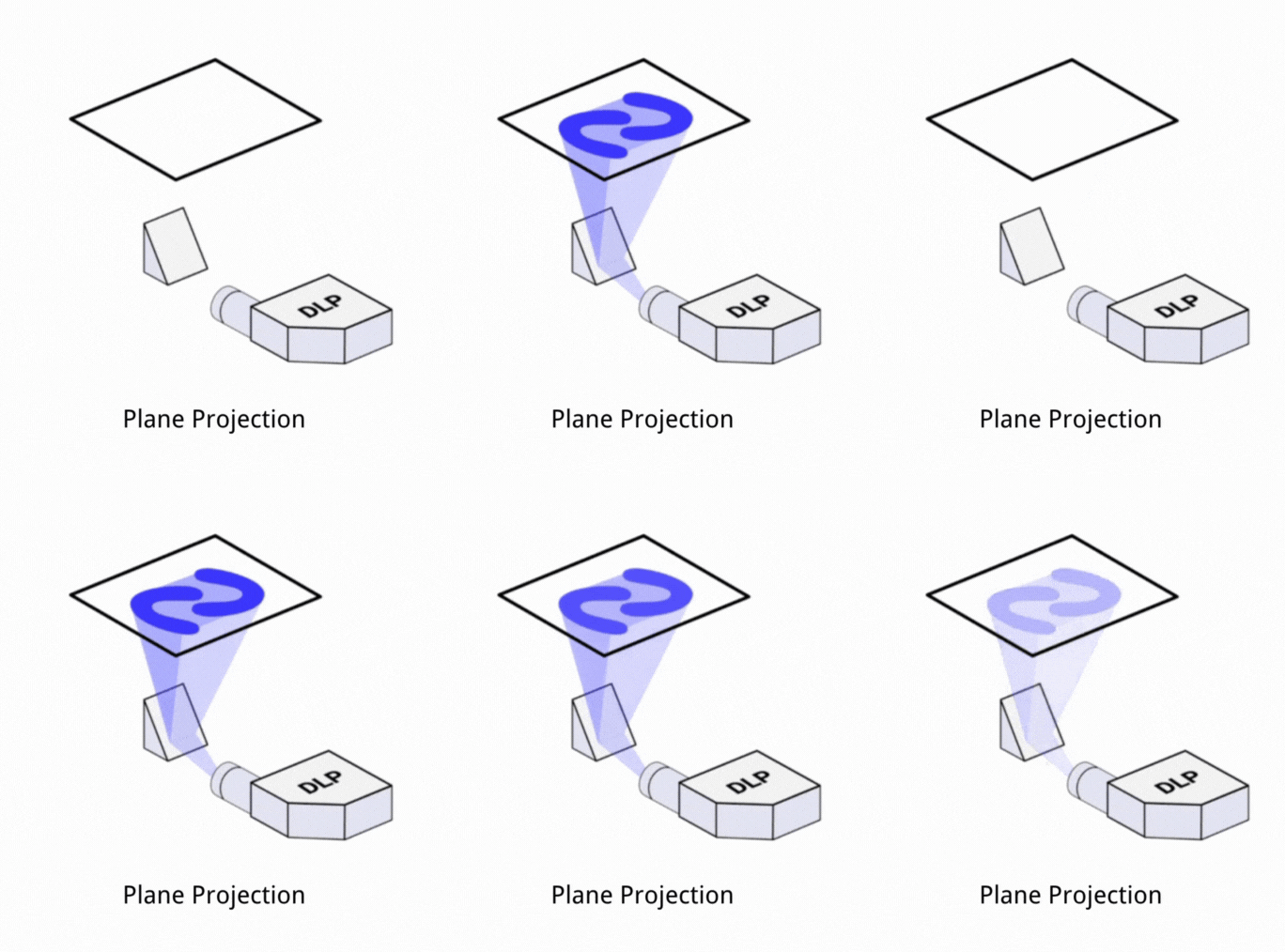
The DMD-based temporal focusing technology enables parallel processing for two-photon line-illumination temporal focusing TPL.
Scanning two-photon lithography is a class of technologies that achieve three-dimensional nanomanufacturing through relative motion between the laser focus or pattern and the sample.
Line-TF TPL achieves true continuous 3D nanofabrication.Through full-bandwidth data streaming and pixel-level grayscale control, the printing throughput is increased by 12.7 times compared to traditional parallel techniques. This technology completely eliminates stitching defects and achieves sub-diffraction-limit precision with lateral 75 nm and axial 99 nm resolution over centimeter-scale areas, providing core driving force for industrial applications in micro-optics, metamaterials, and biomedicine.