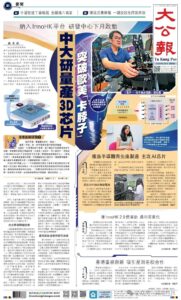

In today’s micro-nano manufacturing field, the industry urgently needs technologies capable of efficiently fabricating complex three-dimensional structures with nanoscale features. The femtosecond projection TPL technology (FP-TPL) developed by our company provides a revolutionary solution, significantly increasing the printing speed at the submicron scale.
Technical Background: Limitations of Traditional TPL
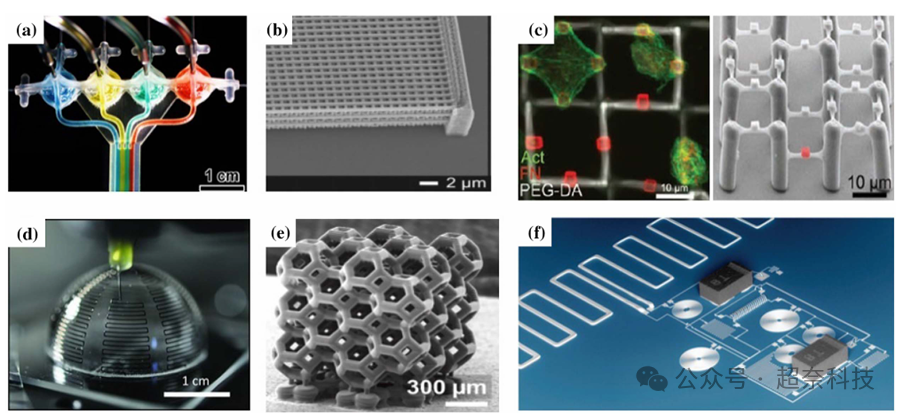
Traditional two-photon lithography (TPL) technology utilizes the principle of nonlinear two-photon absorption, enabling the fabrication of three-dimensional structures with feature sizes of approximately 200 nanometers, and its production rate is faster than that of high-resolution two-dimensional technologies (such as electron beam lithography). However, traditional TPL adopts a point-by-point continuous scanning serial writing method, which is too slow to meet large-scale production demands, and therefore has long been limited to academic and research laboratory applications.
Our Breakthrough: Femtosecond Projection TPL Technology and FP NanoPrinter
The femtosecond projection TPL (FP-TPL) technology developed by our company and its commercialized product, the FP NanoPrinter, achieve parallel manufacturing through spatial and temporal synchronous focusing of ultrafast lasers, increasing printing speed by three orders of magnitude while maintaining nanoscale resolution.
Core Technology Principle
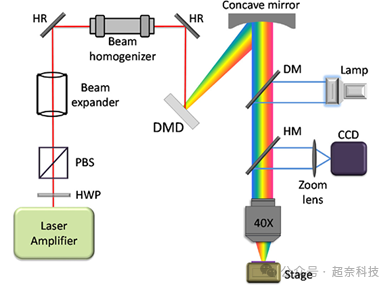
The FP NanoPrinter combines a regenerative femtosecond laser amplifier with a digital micromirror device (DMD), generating depth-resolved programmable light sheets through spatial and temporal focusing. The specific working principles are as follows:
- Digital mask design: Using DMD to structure the light beam into arbitrary 2D patterns
- Temporal focusing technology: Utilizing the broadband characteristics of femtosecond lasers and the diffraction properties of DMD to achieve focusing in the time domain
- Femtosecond light sheet formation: Recombining all dispersed laser spectral components on the focal plane to form a light sheet with the shortest pulse duration
- Synchronization control: Precise synchronization between the femtosecond light sheet and the precision translation stage to create arbitrarily complex 3D micro- and nanostructures
Breakthrough Performance Specifications
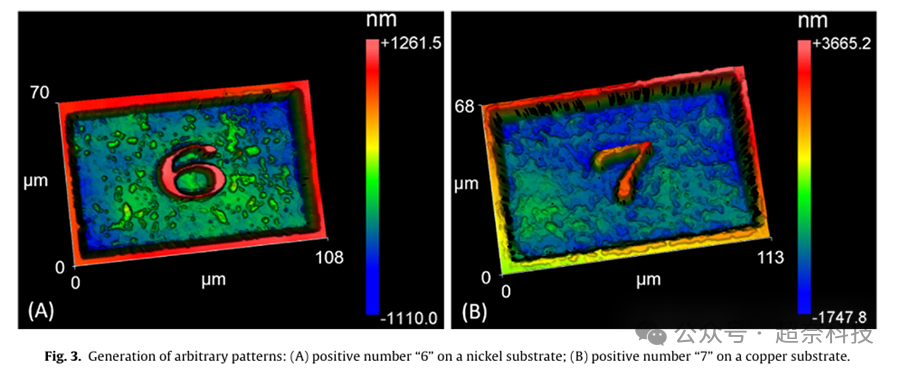
The FP NanoPrinter has achieved significant breakthroughs in multiple aspects:
- Ultra-fast printing: A single exposure (only 1–10 milliseconds) can print an entire plane containing hundreds of thousands of voxels, with a processing rate of approximately 100 cubic millimeters per hour, which is 1,000 times faster than the most advanced commercial solutions
- Ultra-high resolution: Lateral and axial resolutions of 140 nm and 175 nm, respectively, and a minimum feature size of 30 nm can be achieved through special processes
- Enhanced structural strength: Thanks to an optimized voxel aspect ratio of 1:1.25, printed objects have higher structural strength
Significant Economic Benefits
By substantially saving laser operation time, the FP NanoPrinter effectively reduces the printing cost per part by 90%, providing an economically viable solution for the commercial application of micro-nano manufacturing.
Unique Advantages and Application Prospects
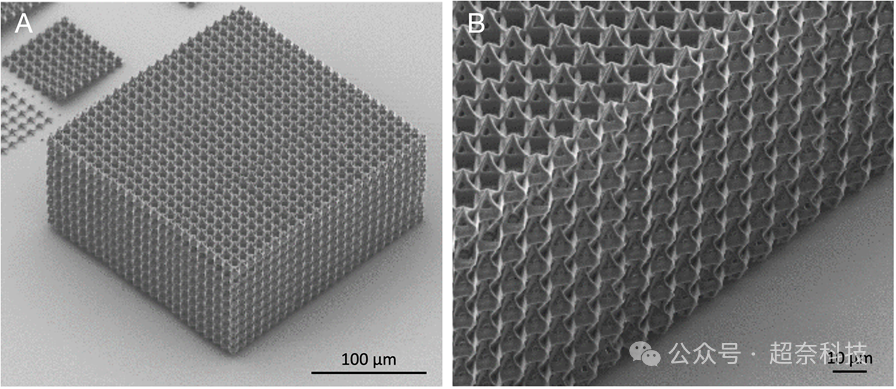
The unique advantages of the FP NanoPrinter are:
- Fabrication of complex overhanging structures: Able to effortlessly fabricate large 3D structures with overhanging parts that were previously unprocessable
- Multi-material integration capability: By depositing multiple materials on expandable hydrogel substrates, functional composite structures can be achieved
- Nanoscale precision control: Through the process of shrinking the gel substrate, a minimum feature size of 30 nm can be achieved
These advantages give the FP NanoPrinter broad application prospects in multiple high-tech fields:
- Photonics: Nano-optical elements, photonic crystals, optical metamaterials
- Medical: Biological scaffolds, drug delivery systems, implantable medical devices
- Automotive industry: Micro-sensors, precision mechanical components
- Aerospace: Lightweight structures, high-strength materials
- Electronic devices: Flexible electronics, microcircuits, sensors