
In recent years, 3D printing technology has penetrated into every aspect of our lives, from industrial production to medical devices, and even household creative fabrication. But what you may not know is that in the microscopic world, scientists are using a technology called “Two-Photon Polymerization” to fabricate precise structures that are completely invisible to the naked eye, with precision reaching the nanometer scale! What is so remarkable about this technology? Today, let’s explore it together.
01 The “Sculptor” of the Microscopic World: What is Two-Photon Polymerization?
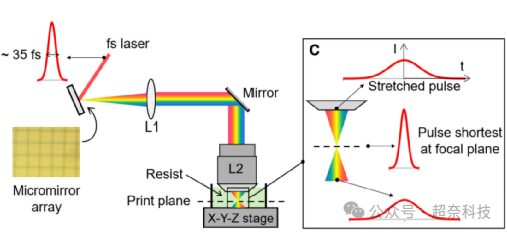
Two-Photon Polymerization (TPP) is an advanced manufacturing technology that can precisely “sculpt” micro- and nano-scale structures in three-dimensional space. Simply put, it uses high-energy lasers to precisely solidify special materials, like a “sculptor” in the microscopic world, capable of creating complex three-dimensional microstructures.
This technology has a very wide range of applications, from micro optical components and biomedical scaffolds to micro-electromechanical systems, where it can be found. And its core secret lies in the term “two-photon.”
02 Starting from “Photosensitive Resin”
To understand two-photon polymerization, let us first get to know its “working material” — photosensitive resin.
This special material mainly consists of three parts:
· Monomers or oligomers: the basic units that form the final solid structure
· Photoinitiators: key molecules that are sensitive to light
· Various additives: used to regulate physical and chemical properties
When the photoinitiator absorbs sufficient light energy, it generates free radicals or cations, triggering a chain reaction of surrounding monomer molecules, ultimately forming a solid network structure — this is the “curing” process.
03 Why is it Called “Two-Photon”? What are the Limitations of Traditional Methods?
In traditional single-photon polymerization technology, one ultraviolet photon is sufficient to activate the photoinitiator. This process occurs in all illuminated regions, causing all material along the light path to be cured, making it difficult to precisely control three-dimensional shapes. Moreover, ultraviolet light has limited penetration depth in materials, and the processing precision can usually only reach the micrometer scale.
Two-photon polymerization, however, is completely different. It requires the photoinitiator molecules to simultaneously absorb two near-infrared photons in order to be activated! This may sound more complex, but it is precisely this complexity that brings breakthrough advantages.
04 The Subtlety of Quantum Physics: Why Does Curing Occur Only at the Focal Point?
Two-photon polymerization involves a subtle quantum physical process:
- The first photon excites the molecule into an extremely unstable “virtual intermediate state,” with a lifetime of only femtoseconds (10⁻¹⁵ seconds)
- Only if the second photon arrives in time within this extremely short period and is absorbed can the molecule reach the excited state
- The excited molecule generates free radicals, initiating the curing of surrounding materials
The key characteristic of this two-photon absorption is that its probability is proportional to the square of the light intensity. This means that when the light intensity is reduced by half, the absorption probability drops to one quarter of the original!
Therefore, only at the laser focal point, where the light intensity is sufficiently high, does two-photon absorption occur significantly. Away from the focal region, the light intensity rapidly decays, and the curing reaction essentially stops. Through a high-precision optical system, this focal “voxel” can be as small as 100–200 nanometers, far exceeding the precision of traditional optical processing.
05 True Three-Dimensional Freedom: The Core Advantages of Two-Photon Polymerization
The most astonishing aspect of two-photon polymerization technology is that it provides true three-dimensional processing freedom:
· Precise positioning: curing can be performed at any location within the material without affecting other regions along the light path
· Ultra-high resolution: the actual cured voxel can be smaller than the traditional optical diffraction limit, reaching the 100-nanometer level
· Deep penetration: the use of near-infrared light provides better penetration, allowing processing deep inside the resin
· High stability: high energy density makes the process less sensitive to environmental factors (such as oxygen)
All these advantages originate from its nonlinear optical process, which causes the curing reaction to exhibit a clear threshold effect — almost no reaction below a certain light intensity, and a rapid increase in reaction above the threshold. This results in extremely sharp processing boundaries with almost no transition region.
06 Future Outlook: Nanotechnology Expanding into Various Fields
Two-photon polymerization technology essentially utilizes nonlinear effects in quantum optics to achieve high-throughput, multi-material, and automated three-dimensional manufacturing.
In the biomedical field, it can fabricate cell-scale tissue engineering scaffolds; in the field of optics, it can create unprecedented micro optical components; in micro-mechanical systems, it can construct complex functional structures. This micro/nano fabrication method based on quantum effects is not only an innovation in manufacturing technology, but also provides us with a completely new way to manipulate matter.